
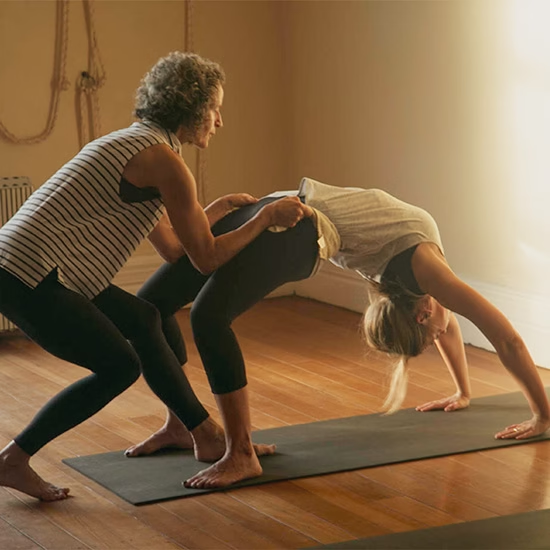
The Art of Sequencing and how to ‘Read a Body’
What is the right practice for me? What is the right practice for my students?
This workshop recognizes the need for adapting a Yoga practice to suit different limitations and conditions. These may be as simple as a lack of time or energy. We will also examine the more therapeutic aspects of the practice and learn how to create a suitable sequence when suffering from a particular condition. Based on the wisdom of Ashtanga Yoga; this includes all eight – astau – limbs of Yoga.
During many of my Yoga-teaching years I watched students who felt compelled to do their ‘full practice’, each time they stepped onto the mat. What does a ‘full practice’ mean?
Even the most committed students sometimes have a day when they do not feel at their best, or they might simply have only limited time available in which to practice. It is difficult to witness those very committed students feeling emotional discomfort when they aren’t able to fulfill their usual program. What is more upsetting is seeing a student who feels there is ‘nothing’ for them to practice due to an acquired injury or some sort of pain, and who then stays away from their practice for a length of time. This is when the old saying becomes relevant: “Yoga has to suit the practitioner, and not the practitioner the Yoga practice”.
In Ashtanga Yoga we follow a set sequence of postures. We can therefore easily get the impression that we have to rigidly stick to this sequence when practicing. But we need to recognize that our needs and capabilities can change from day to day – on certain days we might like to focus and expand on a particular aspect of the practice. With the flexibility gained through Yoga – physical and mental – we can drop unrealistic expectations of ourselves. Using our skill and wisdom, we learn to adapt the practice so that it can further serve us.
In this workshop we aim to investigate and examine:
- the foundational structure of the Ashtanga Yoga sequence; what to keep and what to let go of when amending it.
- the difference between an energizing and a rejuvenating practice, and how to use either.
- which aspects of the Ashtanga Yoga sequence creates strength and/or mobility in different body parts i.e. legs, hips, back, shoulders, arms, core etc., and how to apply those when adapting the practice.
- using selected conditions as examples, i.e. lower back pain, knee pain, hip pain, shoulder pain: – when suffering from an injury, which parts of the practice could be challenging and maybe even worsening the condition and which parts could support the healing process.
- what guidelines to follow when creating a suitable Yoga sequence for yourself and for those who teach.
Learning outcomes
- You will gain a deeper understanding of the why and how of the sequence of Ashtanga Yoga.
- You will be able to create a practice which suits your needs on all levels.
- You will have a better understanding of how to continue to practice and support the healing process, should you injure yourself.
- If you are teaching, you will have improved knowledge of students’ most common issues and injuries, and how to address them in your classes.
- You will have tools and guidelines as to how to create a suitable practice based on the Ashtanga system.
- You will be able to creatively amend your practice should the need arise.
- If you are teaching you will confidently guide your students to adapt their practice safely, suited to their current condition.
- You will foster a positive attitude towards your practice, may it be short, long, simple or more advanced.
Who is this workshop for?
Everyone who is curious about the endless possibilities a Yoga practice offers; based on the wisdom of Ashtanga Yoga.
Practitioners and teachers alike are invited to join.
Schedule & Content
- Sunday, Sep 27th
- Timed practice
- Intelligent Practice Design: How to design a practice for yourself or others based on time, energy levels, and mental state; looking at the practitioner as a whole. We will analyze the structure and purpose of the primary series and integrate beneficial elements from other yoga modalities.
- Saturday, Oct 3rd
- Timed practice
- Shoulder Health: Recognizing Ashtanga postures that potentially strain the shoulders, and finding adaptive ways to practice with a compromised range of movement.
- Sunday, Oct 4th
- Timed practice
- Knee Stability & Care: A focused investigation of postures that challenge or improve knee conditions, and how to build a suitable, safe practice.
- Saturday, Oct 10th
- Timed practice
- The Spine & Back (Part 1): Focused on but not limited to the lower back—creating strength and mobility depending on individual conditions. We will cover safe movement through the primary series, cautions for specific postures, and the mechanics and effects of backbends.
- Sunday, Oct 11th
- Timed practice
- The Spine & Back (Part 2) & Hip Mobility: Continuation of spinal care, plus an exploration of hip mechanics. We will look at postures affected by hip tightness, practice a dedicated re-centering hip sequence, and work to improve joint mobility.
About Angelika
Angelika has been teaching Yoga consistently for 33 years, and is still passionate about the practice. She has guided and educated 22 groups of apprentices through a three-year teacher training. Most of the teachers at NSY have participated in this training. Others have opened their own yoga schools and are thriving in both their practice and their teaching. Angelika loves to foster close and ongoing relationships with her students, and continues to encourage everyone she meets to practice Yoga!
Read more about Angelika’s background.